Saturday, March 6, 2021

Mystery Film


A couple of weeks ago I was browsing the photography section on one of my usual online sales sites, not really planning on buying anything, but you never know, a bargain may pop up, or just something that catches your eye.

As I was scrolling through the many advertisements, some not even catching my attention, I was then drawn to a heading, 'Watson Model 100 Bulk Film Loader..' Now one thing I don't need is another bulk film loader, I already have a Watson, along with a Kaiser bulk loader. But the heading on this one continued, '... Containing 100ft of an unknown brand of film'. I was intrigued.


A bid was made and for the price of a couple of pints of beer I became the owner of another bulk film loader. I was interested in the contents of this film loader, wondering if there was anything viable in there.


After a few days I received the Watson in the post, it was in the original packaging and included all original paperwork. I removed it from the box, I could feel the weight of the film it contained and out of curiosity I popped it into a dark bag to check how much film it contained, I was happy to feel a full 100ft spool, or certainly close to it. 

Now the label on the outside of the holder was interesting, perhaps holding a clue to which film was in this bulk holder. The label showed the ISO to be 1600, it was Fuji black and white, and it was loaded on the 17th June 1997. Was it Neopan?


Neopan was one of my favourite films, in fact the last wedding I shot completely on film was shot on Neopan and every image was beautiful, unfortunately Fuji discontinued Neopan a few years ago. It was time to try remember and research which black and white film rated at 1600 was sold by Fuji back in the 1990's. There was a lot of info to be found, the common one of fast film stock having a shorter life, much talk saying not to waste your time with out of date 1600 film, but I decided to give it a go. I loaded a cartridge with enough film to shoot 12 frames, I threw out a couple of questions on a Face book page I help moderate, Irish Analogue Photography Group. Ideas came back and I decided to shoot this 1600 film at 400 and develop for 800, using Digital Truth's Massive Dev Chart and their time for Neopan 1600 rated at 800. I developed in Kodak HC-110 B dilution for 4 minutes and 45 seconds, to stop I gave the film a one minute water bath, it was fixed for 5 minutes with Ilford Rapid Fixer, washed with a final rinse with liquid dish wash.


When I unspooled the film after it was developed I seen the images were very faint, but the film edge codes and text was clear, I suspected fogged film due to age. A closer look certainly showed the film to be Fuji, further down the film it was clear that it was 1600PR with emulsion number 143. Some forums will tell you this is Fuji Press Rated film, an interesting read in itself, but referencing Fuji's official guide shows it to be Neopan 1600, I have to be honest and say I can't say for sure if Fuji Press Rated film is in the Neopan range of film, Fuji did make a Color Press film, the batch I have is certainly black and white. 


After scanning it was clear this film was heavily fogged, most likely due to its age and the fact that fast film does not last as long as some of the slower film speeds, but is it a non runner? I don't think so, judging by what I got from it I would consider using this for a project of some sort, I plan on shooting more and trying different times but there's no doubt about the fog.

Technical data; Camera - Leica M6 | Lens - Voigtlander Color Skopar 35mm f2.5 | Film - Fuji Neopan 1600 expired two decades (estimate) | Developer - Kodak HC-110 B dilution | Stop bath - Water | Fixer - Ilford Rapid Fixer | Scanner - Epson Photo V850 Pro


©Jim Leonard

Sunday, February 14, 2021

Fuji GW690II Professional - A Review

     Fuji GW690II     

I've been a fan of rangefinder cameras for sometime now, I've owned and shot a few from a Zorki 4, Yashica Electro 35, Ricoh 500, various Leica models and a Mamiya 6 Medium Format rangefinder, but not necessarily in the order. The Fuji list of rangefinders have interested me over the years, they come in a range of different frames sizes and all from a roll of 120 Medium Format film.

This week I got my hands on a Fuji GW690II Professional 6X9, this model which comes with a Fujinon f3.5 90mm lens which equates to 45mm when compared to 35mm film lenses. This camera is a Medium Format camera shooting 120 film (it can also take 220 film), each negative measures 6x9cm in which you can capture beautiful detail, you get eight frames to a roll of 120. The GW690II was manufactured from 1985 through to the early/mid 1990's. It's a well built camera with a solid feel to it, loading the film is easy, it has two shutter release buttons for landscape and portrait modes, winding the film to the next frame is done with a double stroke, the same as the earlier model Leica M3.

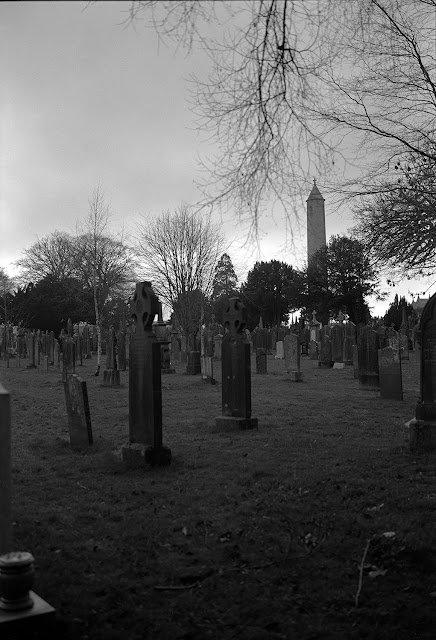
     Glasnevin Cemetery, Fuji GW690II, Ilford HP5+ rated at ISO800

It was time to test this camera and with travel restrictions in place due to the Covid-19 pandemic I did not have many options, I chose to visit Glasnevin Cemetery on the north side of Dublin. Opening in 1832 Glasnevin Cemetery has seen the internment of over 1.5 million people.

                               Glasnevin Cemetery, Fuji GW690II, Ilford HP5+ rated at ISO800

I packed the big Fuji into my bag along with a couple of rolls of Ilford HP5+ black & white Medium Format film and made the short journey to the cemetery. The weather was bitterly cold, overcast and dull, I opted to push the film to ISO 800 which would help with the poor light and increase the contrast, which I like.

     Glasnevin Cemetery, Fuji GW690II, Ilford HP5+ rated at ISO800


                               Glasnevin Cemetery, Fuji GW690II, Ilford HP5+ rated at ISO800

I was pleasantly surprised with the handling of the Fuji, it's a big camera, so much in fact it's nicknamed the Texas Leica by some. The grip is comfortable and the additional shutter release button is quite handy.

      Glasnevin Cemetery, Fuji GW690II, Ilford HP5+ rated at ISO800

     The Crematorium, Fuji GW690II, Ilford HP5+ rated at ISO800

                                The Crematorium, Fuji GW690II, Ilford HP5+ rated at ISO800

       Glasnevin Cemetery, Fuji GW690II, Ilford HP5+ rated at ISO800

As already mentioned, the weather wasn't great but the combination of the Fujinon 90mm EBC (Electron Beam Coating) lens and Ilford HP5 pushed to 800 made capturing these images a pleasure, or as enjoyable as one can be when photographing a cemetery. The Fuji GW690II really is a handful, it's a big camera and attracts attention, however you can carry it quite easily on a neck strap, it's much easier to carry and a lot more portable than my Hasselblad 501cm, but it would never replace the Hasselblad. I'm going to hold onto the Fuji for a while, I like the feel of it, I love the big 6x9 centimetre negatives and I'm really looking forward to putting a roll of Kodak Portra of Ektar through it, just as soon as the weather brightens up and improves.

Technical details-
Camera; Fuji GW690II
Film; Ilford HP5+ 120 rated at ISO 800
Developed in Kodak HC-110 in dilution B

All images ©Jim Leonard


Sunday, November 1, 2020

Lockdown Project

As we all know by now 2020 has so far been a strange and difficult year for many, the Covid-19 virus has changed the way we live, the way we socialise, the way we seek and portray our art. In fact a lot of us will have suffered from a lack of enthusiasm as we try to keep ourselves busy with travel restrictions in place and no chance to really socialise or mingle. 

During the full lockdown some months ago I created my own project of gathering local history from where I live, visiting old churches and schools, exploring the canal walk that runs close to my home, I photographed as much as I could within the restricted limit of 2kms which later changed to 5kms.
      Clonsilla School (1854). Rolleiflex T, Ilford HP5. ©Jim Leonard


Rediscovering your local history can be fascinating, searching local archives, seeking out interesting buildings and making connections that made your locality what it is, you get to walk in the footsteps of those who lived there before you.


      St. Mary's Church (1840-1850) Rolleiflex T, Ilford HP5  ©Jim Leonard


As photographers we often choose a project based on the camera we use, the film we have selected for that project, or the subject, which is probably the most common. My own projects are generally associated with events, travel and/or culture.


As we enter into another phase of Covid-19 restrictions I thought about another lockdown project, and I guess this isn't really lockdown as we know it, many business's are thankfully still open so the economy, as much as it has suffered, is still turning over, again however, these restrictions prevent us from running and attending social events, it has certainly effected my skinhead project of which I had hoped to be in the final stages of compiling a book, perhaps I could work on something else to get a selection of those images out there, a zine perhaps?!

Now we're down to travel restrictions of just 5kms from our home in an attempt to bring the Covid positive numbers down, as photographers what do we do if we want to continue creating whilst staying within the restricted limits? I guess it very much depends on where you live, if you live in the centre of a city then you have an abundance of undiscovered streets and buildings to choose from, although footfall is down so street photographers may need to diversify. So what about those of us who live in the suburbs or countryside? do we just go out and photograph the same buildings and streets as we did during the last lockdown? Well I guess we do, but we too can diversify, yes we are about to take the same walks along the same streets or canal walks we've been doing through the Spring and Summer, photographing those interesting buildings steeped in local history, or a hill walk or walkway with interesting views.


      Royal Canal Walk Clonsilla. Nikon D500 ©Jim Leonard


New Project

Most of my projects are shot on film, or a mix of film and digital, so I thought about how I was going to approach my new project which involved photographing the same locations I had photographed during the first lockdown without losing interest to both the photographer and the viewer. I browsed ideas, checking in with other photographers and what their thoughts were on new projects with the same subjects. After much thought and research I decided I'd shoot the same topics and locations but with one theme in common, I chose to shoot the same locations on a specific film, but which film?


                 Developing paper negatives in the darkroom ©Jim Leonard


After much thought, research and internet browsing I decided to choose a specific film to shoot the same buildings and walkways I had shot during the Summer. This time around with Autumn changing to Winter I decided to choose reversal film, or slide film as most would know it by, black & white was my choice this time. 

Colour Reversal film was very popular a few years ago, it oozed colour and punched that image right to the viewer. Unfortunately the use of reversal film reduced over the years, in particularly since the introduction of digital photography and the number of labs who processed this E6 developing fell dramatically resulting in many labs closing with zero number of commercial labs processing reversal film in Ireland in 2020.

      Fire Station Budapest. Leica M6, Fuji Velvia 100 ©Jim Leonard


Fomapan R100

After deciding I would select film as my main project point of these new restrictions I decided on reversal film, a complicated yet beautiful process which often gave incredible results, even though metering and processing temperature requirements were quite precise. I had previously been a fan of black and white reversal film and although this film had largely disappeared I knew that Foma still produced such film, they even produced a reversal developing kit to go with their branded film, credit to Foma for that.

      A package from Czech Republic

After shopping around for the best prices on Fomapan R100 I chose to order straight from their factory in Czech Republic, a country I visit every year and pass close to their factory on my travels, something I only discovered this week, perhaps on my next trip I might get to visit the factory. 

After browsing the website of Foma and setting up an account I placed my first order.

     Fomapan R100 Black & White Reversal film

After a few days my order arrived from the Foma factory, everything was well packaged and the carton carried an advisory notice stating that film products were contained, I'm hoping this resulted in gentle handling by customs. I ordered a 30.5m roll of film which I will load into 35mm cassettes using my Kaiser bulk film loader.

     Foma photographic paper which was a complimentary addition to the delivery


                      Fomapan R processing kit
              

So that's the new project almost set up, the locations will be familiar but the results will be different as I haven't shot on black and white reversal film for a few years now. 

Stay tuned for the results.

Jim

Road Trip to Newry

London-Newry, a fictitious town in the country of Irelantis created by the incredible artist that is Sean Hillen. I recently enjoyed a road ...